
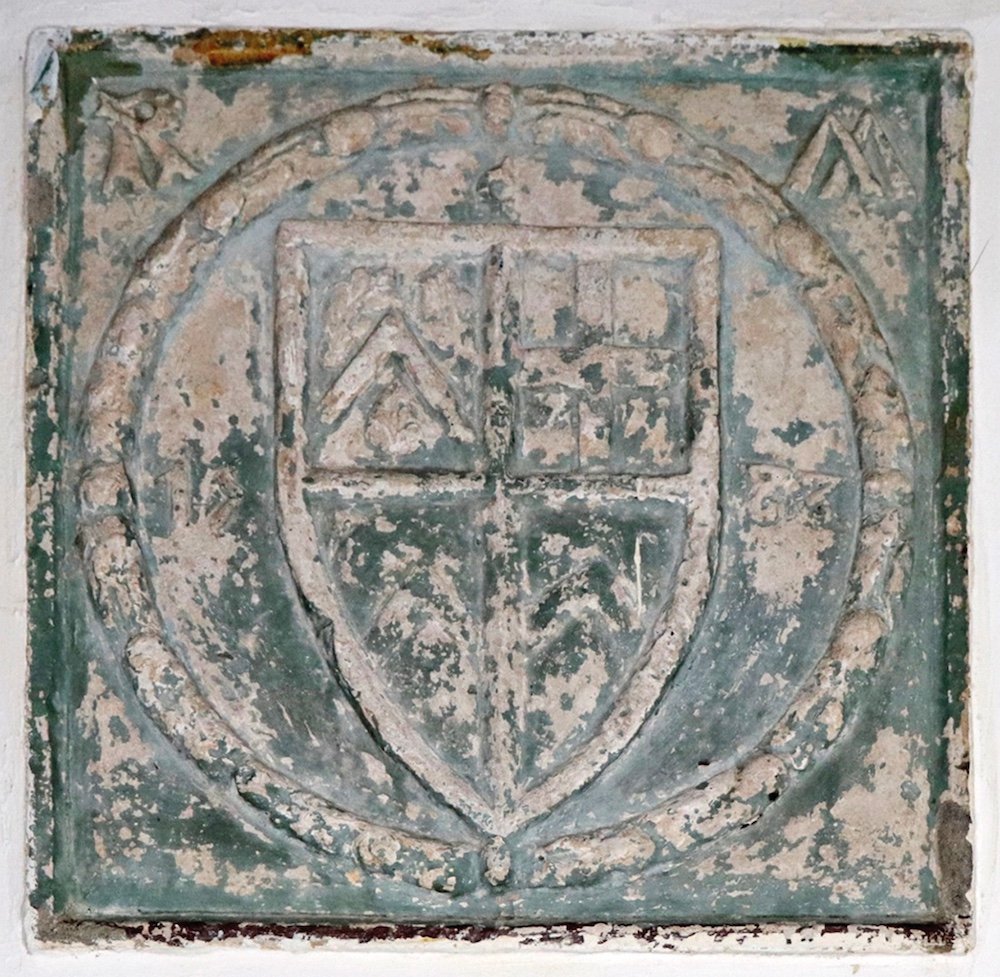
There is an unobtrusive plaque on the wall above the church pulpit, the only really old one in the church. It bears the initials RM and worn and nearly indecipherable dates and a coat of arms, attributed by some to Sir Rice Mansel of Oxwich and Margam; further research reveals this to be unlikely, as one date is 1583, many years after Sir Rice’s death, and what can be discerned of the arms does not include a known Mansel element. It is possible that Emily Talbot, benefactress of the church, installed the plaque knowing or at least thinking that it represented her ancestor.
It still offers an excuse to retell the tale of the Battle of Oxwich Castle, December 1557.
Sir Rice (1487-1559) seems to have been a colourful character, descendant of Mansel men who had always been on the winning side with their respective kings; thus Rice found favour and a knighthood from Henry VIII as one of his ‘new men’ and was able, at the Dissolution of the monasteries, to buy Margam Abbey (not the current build-ing) and rebuild his old castle at Oxwich into the fortified manor house still called a castle. Mansels had married de Penrices , thus taking ownership of the old Penrice Castle. Rice Mansel abandoned this in favour of Oxwich and was living there (or not?) at the time of an episode on St. Stephen’s Day, 1557. By now the Mansels owned half of Gower and Rice served as High Sheriff at one stage.
Actually, Rice missed all the fun involved in the wreck of a French vessel carrying raisins, figs and almonds (a bit late for Christmas) as he was absent from Oxwich, per-haps keeping Christmas at Margam. Anyway, the castle steward Gruffydd was dining at the Rectory beside the shore and lost no time in rushing to tell Rice’s son Edward of the potential for looting. Edward may have been at Gruffydd’s home in Slade, or visiting his aunt Anne at Henllys, Llanddewi. Meanwhile, Oxwich villagers & Mansel servants captured the Frenchmen, who were enemies, and got on with salvaging the goods.
Shortly, there arrived on the scene one Sir George Herbert of Swansea, owner of another large chunk of Gower and, crucially, the coastal rights. Not to be done out of his dried fruits and also valuable fittings from the wrecked ship, Sir George distrained much of the loot and the prisoners, and chased after Edward for his gleanings. In the absence of his father, Edward, backed by his aunt who had followed him home, seems to have at first agreed to let an inventory be taken, then met Sir George and his party at the castle gate with a platoon of his own, some armoured and others wielding cudgels and sticks. Insults were exchanged and a few slight blows; then came the di-sastrous move by one of Herbert’s followers, Watkyn: he picked up and hurled a large stone which struck Anne on the head and caused her a fatal wound, of which she died on New Year’s Day.
Horrified by this unchivalrous event, Sir George and party left in haste, but the dam-age was done. An inquest blamed the whole lot of them and later the Mansels took Sir George before the Star Chamber, by whom he was heavily fined. You can be sure that relations between Herberts and Mansels were not good henceforth.
There are still several Mansel descendants in Gower, though the name has died out, only occurring as a second name of many family members.